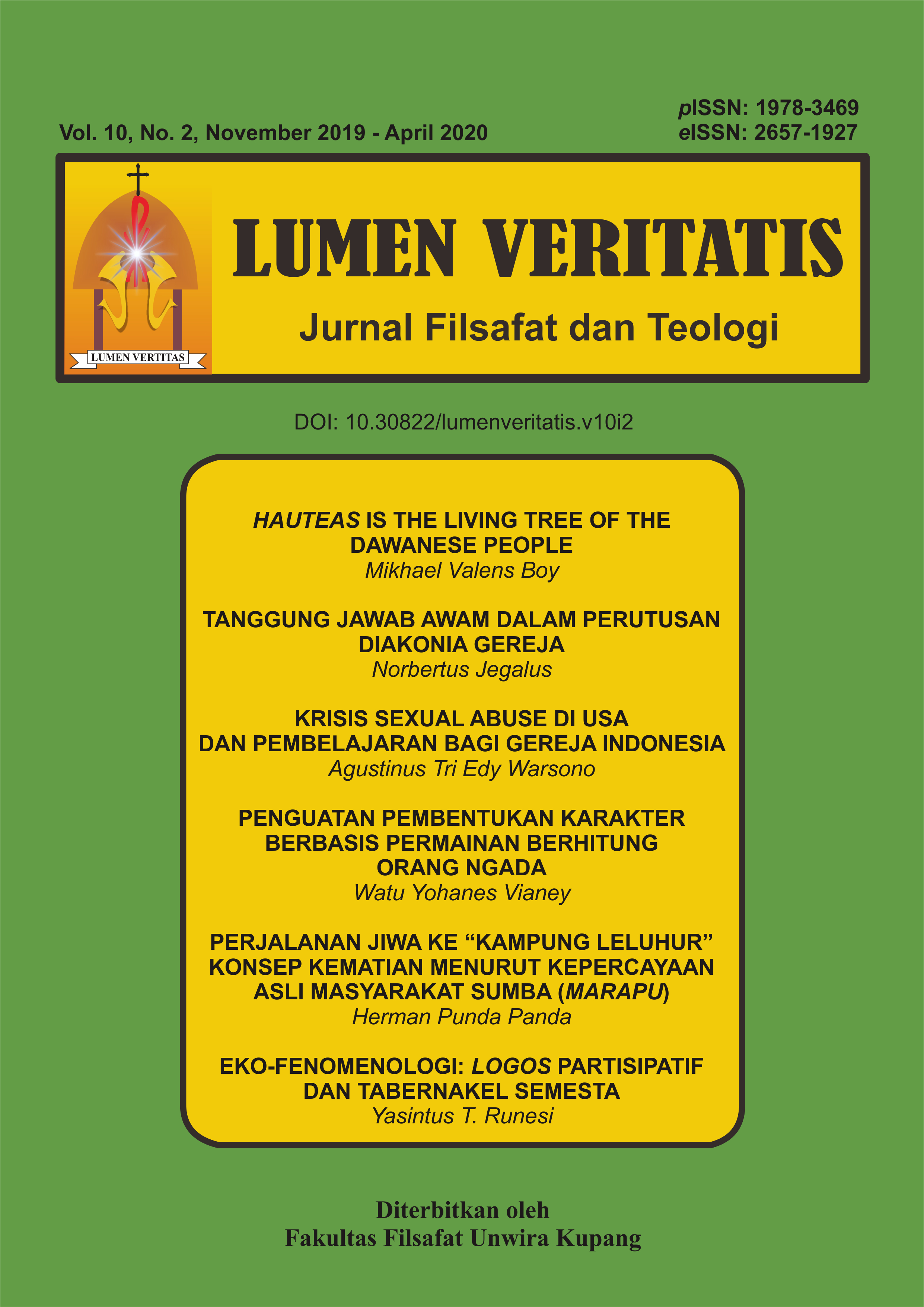
PERJALANAN JIWA KE “KAMPUNG LELUHUR” KONSEP KEMATIAN MENURUT KEPERCAYAAN ASLI MASYARAKAT SUMBA (MARAPU) DAN PERJUMPAANNYA DENGAN AJARAN KATOLIK
DOI:
https://doi.org/10.30822/lumenveritatis.v10i2.478
Keywords:
Hidup setelah mati, Upacara, Marapu, Katolik, PerjumpaanAbstract
This study answers a phenomenon of double funeralrite that often occurs among the Catholics who converted from Marapu, the ethnic religion of the people of Sumba. Double funeralrite is the practice of funeral ceremonies consisting of official liturgy of the Catholic Church and spontaneously followed by a number of Marapu rites. Such a practice indicates a dualism of belief, in the sense that people have embraced the Catholic faith but are still attached to the elements of their old beliefs. In this study the author investigates in depth both the funeral rites according to Marapu and the double practice phenomenon in funeral ceremonies of Catholics who converted from Marapu. The main purpose of this research is to find parallels and intersections between Catholic’s concept of life after death and that of Marapu’s. Discussion and analysis of the data prioritizes the meaning behind each verbal and non-verbal expression. The meaning of prayers, rituals and symbols used in funeral according to Marapu reveals universal values ??that parallel to the values ??contained in Catholic teaching. According to Marapu belief, death is the return of the soul towards “ancestral village”, which is the final resting place of souls after death. This return is believed to be a long journey before arriving at the ancestral village. Prayers and ceremonies carried out by humans aim to help the soul to enter the ancestral village. This concept parallels to the Catholic understanding of soul purification after death before entering the eternal happiness in Heaven. Such parallels allow a construction of the encounter between Catholic teachings and Marapu ones about life after death.
References
Benedictus XVI, Cathechismo della Chiesa Cattolica (Citta del Vaticano: Ibreria Editrice Vaticana, 2005) diterjemahkan oleh Harry Susanto SJ dengan judul Kompendium
Katekismus Gereja Katolik (Jakarta – Yogyakarta: Konferensi Waligereja Indonesia – Kanisius, 2009)
Boli Ujan, B dan G. Kirchberger (Ed.), Liturgi Autentik dan Relevan (Maumere: Ledalero, 2006).
Bungin, B., Penelitian Kualitatif Komunikasi, Ekonomi, Kebijakan Publik, dan Ilmu Sosial Lainnya (Jakarta: Kencana, 2009).
Denzinger, H., Enchiridion Symbolorum, Terjemahan Bahasa Inggris Roy J. Deferrari, The Sourcess of Catholic Dogma (London: B. Herder Book Co, 1957)
Diester, N.S., Teologia Sistematika 2 (Yogyakarta: Kanisius, 2004).
Forth, G.L., “Rindi, an Ethnographic Study of a Traditional Domain in Eastern Sumba”, dalam Verhandelingen van het Koninklijk Instituut voor Taal-, Land en Volkenkunde 93 (The Hague: 1981).
Haripranata, H., Ceritera Sejarah Gereja Katolik Sumba dan Sumbawa, (Ende: 1984).
Hesselgrave, D.J dan Edward Rommen, Kontekstualisasi: Makna, Metode dan Model, Terjemahan Stephen Suleeman (Jakarta: BPK Gunung Mulia, 2004).
Hoskins, J, “So my name shall live: Stone-dragging and Grave-building in Kodi, West Sumba”, dalam Bijdragen tot de Taal-, Land en Volkenkunde, 142 (The Hague: 1986).
_____, The Play of Time, Kodi Perspectives on Calendars, History and Exchange (Berkeley: University of California Press, 1993).
Iskandar, Metodologi Penelitian Kualitatif (Jakarta: Gunung Persada Press, 2009)
Kirchberger, G. dan John M. Prior (eds.) Iman dan Transformasi Budaya (Ende: Nusa Indah, 1996)
Nudu, N.A.M., Pertemuan Marapu dengan Yesus Kristus (Skripsi, Yogyakarta: 1983)
_____, “Iman Kristiani dan Marapu” dalam Kaleidoskop Gereja Katolik Sumba dan Sumbawa 1889-1989, (Weetebula: Panitia Perayaan Seratus Tahun Gereja Katolik di Sumba, 1989), hlm. 92-99.
Panda, H.P., “Usaha Penyesuaian Liturgi dalam Budaya Sumba dan Konteks Kepercayaan Marapu”, dalam Boli Ujan B. dan G. Kirchberger, Liturgi Autentik dan Relevan (Maumere: Ledalero, 2006).
_____, ”Mengapa Orang Katolik Masih Menjalankan Ritual Marapu? Menguak Praktik Iman Ganda di Loura” dalam Jurnal Ledalero, Vol. 13, No. 1, Juni 2014.
Pieris, “Interreligious Dialogue and Theology of Religions: An Asian Paradigm”, dalam East Asian Pastoral Review 29 (1992), 365-376.
Prior, J.M., Bejana Tanah Nan Indah: Refleksi Sosio-Budaya atas Jemaat-Jemaat Basis Nusa Tenggara Sebagai Wujud Evangelisasi Baru (Ende: Nusa Indah, 1993).
Wellem, F.D., Injil dan Marapu, suatu Studi Historis-Teologis tentang Perjumpaan Injil dengan Masyarakat Sumba pada Periode 1876-1990, (Jakarta: BPK Gunung Mulia, 2004).
Woga, E., Der Parentale Gott: Zum Dialog zwischen der Religion der indonesischen Völker Sumbas und dem Christentum (Nettetal: Steyler Verlag, 1994).
Yohanes Paulus II, Paus, Redemptoris Missio, Ensiklik (7 Desember 1990), Terjemahan Marcel Beding (Ende: Nusa Indah, 1992).