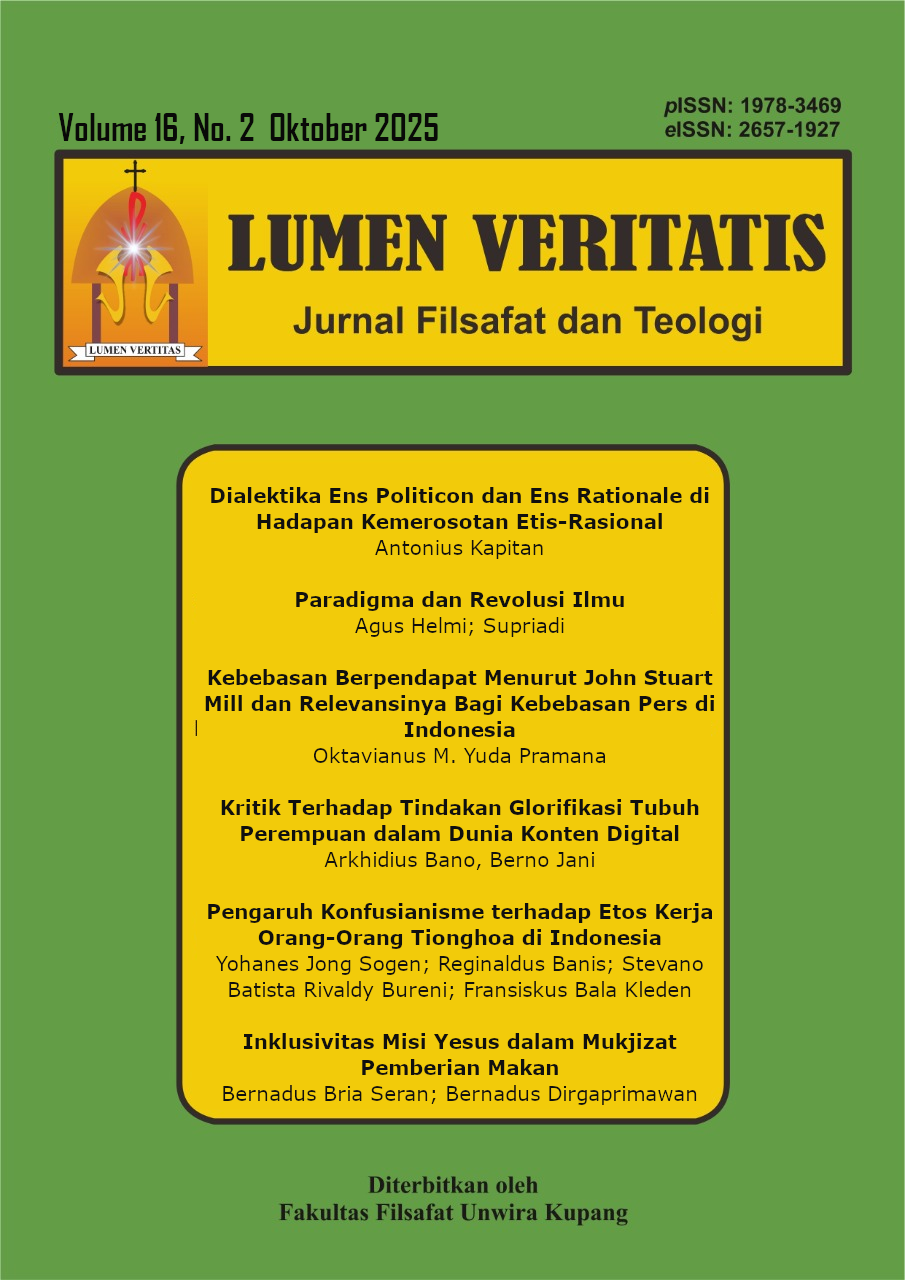
Kebebasan Berpendapat Menurut John Stuart Mill dan Relevansinya Bagi Kebebasan Pers di Indonesia
DOI:
https://doi.org/10.30822/yfkcka49
Keywords:
John Stuart Mill, kebebasana berpendapat, prinsip cedera, kebebasan persAbstract
This article examines John Stuart Mill's concept of liberty of expression in his work, On Liberty, and its relevance to the current state of liberty of press in Indonesia. Using a qualitative approach through literature review, this research analyzes Mill's key ideas: individual liberty, liberty of thought and discussion, harm principle, and the dangers of the tyranny of the majority, and relates these to the actual reality of press freedom in Indonesia. The analysis shows that although the liberty of expression is constitutionally guaranteed, its practice remains constrained by repressive regulations such as the Electronic Information and Transactions Law (UU ITE), violence against journalists, and intimidation of critical media outlets. Mill emphasized the importance of distinguishing between the private and public spheres, the role of discussion in the search for truth, and the limitation of liberty only when it causes tangible harm. The conclusion is that Mill's liberal principles can serve as an ethical basis for reforming Indonesian democracy, particularly in strengthening legal protections and democratic culture to guarantee the liberty of press.
References
Bell, Melina Constantine. “John Stuart Mill’s Harm Principle and Free Speech: Expanding the Notion of Harm.” Utilitas 33, no. 2 (June 2021): 162–79. https://doi.org/10.1017/S0953820820000229.
Brown, D.G. “The Harm Principle.” In A Companion to Mill: Blackwell Companions to Philosophy. Hoboken: Wiley Bleckwell, 2017.
Capaldi, Nicholas. John Stuart Mill: A Biography. New York: Cambridge University Press, 2004.
Herry-Priyono, B. Kebebasan, Keadilan, Dan Kekuasaan: Filsafat Politik and What It Is All About. Jakarta: Penerbit Buku Kompas, 2022.
“Indonesia | RSF.” Accessed August 19, 2025. https://rsf.org/en/country/indonesia.
Kateb, George. “A Reading of On Liberty.” In On Liberty. Rethinking the Western Tradition. New Haven and London: Yale University Press, 2003.
“Krisis Kebebasan Pers Di Tengah Darurat Iklim Dan Erosi Demokrasi Laporan Situasi Keamanan Jurnalis Indonesia 2023 | AJI - Aliansi Jurnalis Independen.” Accessed August 19, 2025. https://aji.or.id/data/krisis-kebebasan-pers-di-tengah-darurat-iklim-dan-erosi-demokrasi-laporan-situasi-keamanan.
Masferrer, Aniceto. “The Decline of Freedom of Expression and Social Vulnerability in Western Democracy.” International Journal for the Semiotics of Law - Revue Internationale de Sémiotique Juridique 36, no. 4 (August 2023): 1443–75. https://doi.org/10.1007/s11196-023-09990-1.
Mill, John Stuart. On Liberty. New Haven and London: Yale University Press, 2003.
Nord, Marina, Martin Lundstedt, and Staffan I Lindberg. MEDIA FREEDOM, DEMOCRACY, AND SECURITY. n.d.
Poff, Deborah C. “John Stuart Mill’s Concept of the Harm Principle.” In Encyclopedia of Business and Professional Ethics, 1185–87. Springer, Cham, 2023. https://doi.org/10.1007/978-3-030-22767-8_759.
Rachel Humayra and Meyniar Albina. “Model-Model Penelitian Kualitatif.” Jurnal Nakula?: Pusat Ilmu Pendidikan, Bahasa dan Ilmu Sosial 3, no. 5 (June 2025): 241–45. https://doi.org/10.61132/nakula.v3i5.2204.
Remanu, Alifah, Calista Purwanto, Nadhira Fajri, and Firman Lukman. “Analisis Implikasi UU ITE Terhadap Kebebasan Berekspresi di Ruang Digital: Studi Kasus Greenpeace Indonesia.” Jurnal ISO: Jurnal Ilmu Sosial, Politik dan Humaniora 4, no. 2 (December 2024): 11. https://doi.org/10.53697/iso.v4i2.1984.
Riley, Jonathan. The Routledge Guidebook to Mill’s On Liberty. London and New York: Routledge, 2015.
Rizky Pratama Putra Karo Karo. “Hate Speech: Penyimpangan terhadap UU ITE, Kebebasan Berpendapat dan Nilai-Nilai Keadilan Bermartabat.” Jurnal Lemhannas RI 10, no. 4 (January 2023): 52–65. https://doi.org/10.55960/jlri.v10i4.370.
Susanti, Diah Imaningrum. “Kebebasan Berekspresi Dan Ujaran Kebencian: Kajian Filsafat Hukum Terapan.” SAPIENTIA ET VIRTUS 7, no. 2 (October 2022): 100–125. https://doi.org/10.37477/sev.v7i2.363.
Tempo. “Komnas HAM Sesalkan Kasus Penghapusan Opini di Detikcom karena Penulisnya Mengaku Diintimidasi | tempo.co.” Mei | 09.15 WIB 2025. https://www.tempo.co/hukum/komnas-ham-sesalkan-kasus-penghapusan-opini-di-detikcom-karena-penulisnya-mengaku-diintimidasi-1553499.
Ten, C.L. Mill’s On Liberty: A Critical Guide. New York: Cambridge University Press, 2009.
Waruwu, Marinu. “Pendekatan Penelitian Pendidikan: Metode Penelitian Kualitatif, Metode Penelitian Kuantitatif Dan Metode Penelitian Kombinasi (Mixed Method).” Jurnal Pendidikan Tambusai 7, no. 1 (2023): 2896–910.
Yuda Pramana, Oktavianus M. “Prinsip Cedera dalam Hubungan Kebebasan dan Otoritas Menurut John Stuart Mill.” Dekonstruksi 9, no. 04 (September 2023): 33–44. https://doi.org/10.54154/dekonstruksi.v9i04.189
Downloads
Published
Issue
Section
License
Copyright (c) 2025 Oktavianus Murtianto Yuda Pramana

This work is licensed under a Creative Commons Attribution-NonCommercial 4.0 International License.